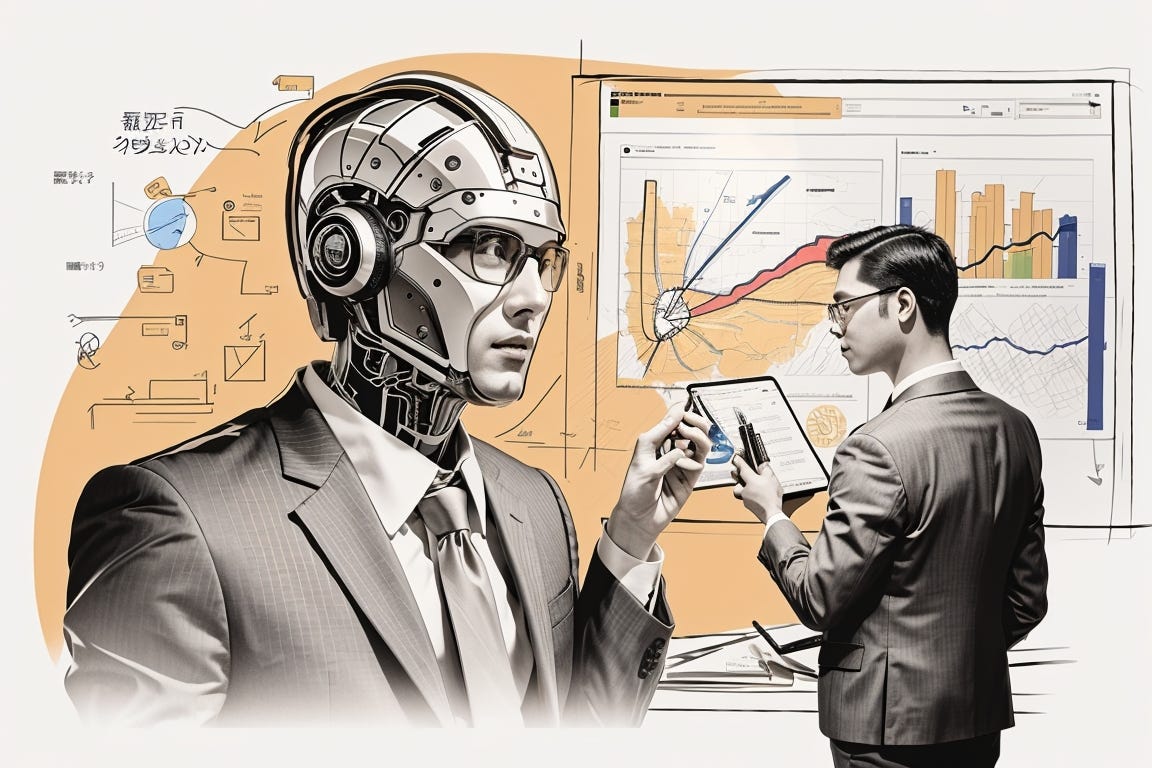
Artificial intelligence (AI) is quickly becoming a key component in current commercial decision-making. Its ability to handle vast amounts of data quickly and accurately is revolutionizing how businesses operate, innovate, and compete across industries.
Enhanced Data Analysis
AI excels at processing complex datasets to reveal previously unachievable insights. Machine learning algorithms, for example, can more accurately forecast consumer behavior, optimize logistics, and detect fraudulent activity than traditional approaches (Kaplan and Haenlein, 2019). Businesses may use AI to make better decisions, save expenses, and increase efficiency.The Impact of Artificial Intelligence on Business Decision Making:
Automated Decision Processes
Automation of everyday work is another key advantage of AI. Algorithms may increasingly automate decisions that do not require human interaction, such as modifying e-commerce prices or maintaining inventory levels in response to expected demand (Agrawal, Gans, and Goldfarb, 2018). This automation not only speeds up decision-making but also lowers the possibility of human error.
Real-time problem-solving
AI also allows for real-time problem solutions in sectors like customer service. AI-powered chatbots may handle basic customer requests without human interaction, offering rapid responses 24/7. This enhances the customer experience while freeing up human agents to handle more complicated issues (Huang and Rust, 2018).

Strategic Decision-making
On a strategic level, AI can evaluate market patterns and rival behavior, providing insights to aid strategic planning. For example, AI systems may simulate numerous business scenarios using accessible data, assisting executives in visualizing prospective outcomes and planning appropriately (Brynjolfsson and McAfee, 2017).
Conclusion
To summarize, AI is a strong tool for improving commercial decision-making. It has the potential to automate operations, improve data analysis, and deliver strategic insights, resulting in major competitive advantages. As AI technology advances, it will become increasingly integrated into business strategy, making it critical for businesses to understand and utilize AI responsibly and effectively.
References
Agrawal, A., Gans, J., and Goldfarb, A. (2018) Prediction Machines: The Simple Economics of Artificial Intelligence. Harvard Business Review Press.
Brynjolfsson, E. and McAfee, A. (2017) Machine, Platform, Crowd: Harnessing Our Digital Future. W.W. Norton & Company.
Davenport, T.H. (2018) 'The AI Advantage: How to Put the Artificial Intelligence Revolution to Work'. MIT Press.
Huang, M.-H., and Rust, R.T. (2018) ‘Artificial Intelligence in Service’, Journal of Service Research, 21(2), pp. 155-172.
Kaplan, A. and Haenlein, M. (2019) ‘Siri, Siri, in my hand: Who’s the fairest in the land? On the interpretations, illustrations, and implications of artificial intelligence’, Business Horizons, 62(1), pp. 15-25.
Comments
Post a Comment